
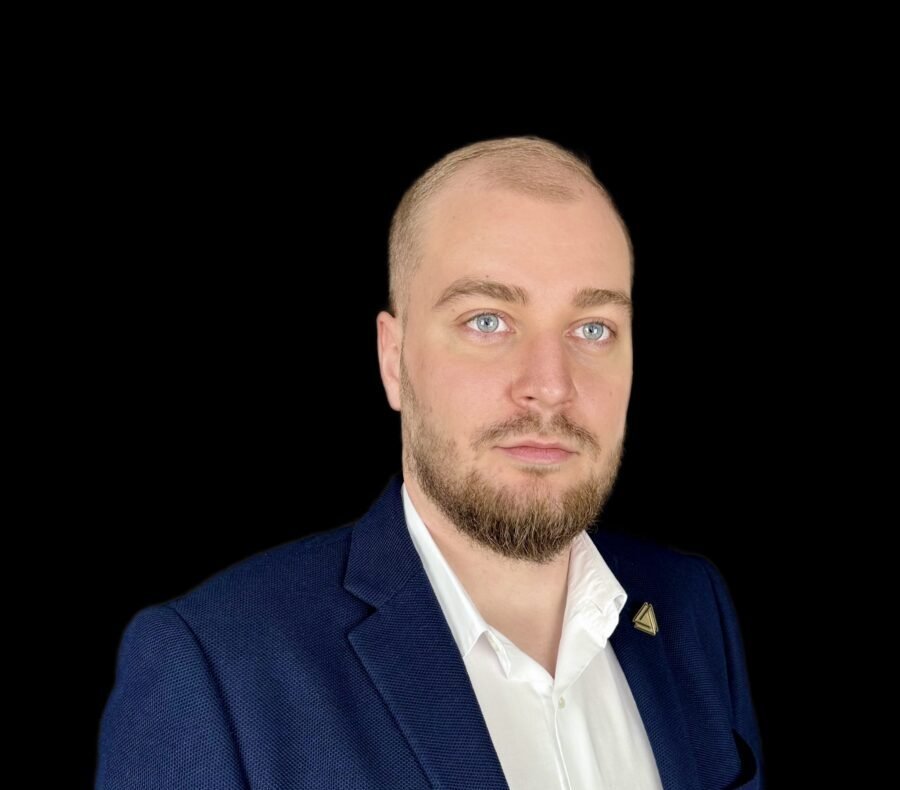
Full original interview → https://valiantceo.com/ai-strategy-with-dmitry-marinov-of-any-run/

Dmitry Marinov of ANY.RUN explains how artificial intelligence can connect security operations with executive priorities. His approach centers on faster decisions; clearer communication; measurable efficiency; and human accountability. For technology leaders building stronger professional networks and more resilient organizations; this interview offers practical ideas for turning cybersecurity expertise into business value.
Dmitry Marinov is the CTO of ANY.RUN, a global cybersecurity platform trusted by analysts in over 190 countries. He leads the development of high-performance systems that process terabytes of threat data.
Dmitry has over nine years of experience in cybersecurity software engineering and architecture and has played a central role in shaping the company’s threat intelligence and advancing its global reach. He is also an active voice in the industry, regularly speaking and participating at leading events such as GITEX and GISEC. His career has been dedicated to creating technologies that help security teams respond faster, see clearer, and act with confidence — combining technical innovation with practical value for organizations worldwide.
Company: ANY.RUN
We are thrilled to have you join us today, welcome to ValiantCEO Magazine’s exclusive interview! Let’s start off with a little introduction. Tell our readers a bit about yourself and your company.
Dmitry Marinov: Dmitry Marinov is the CTO of ANY.RUN, a global cybersecurity platform trusted by analysts in over 190 countries. He leads the development of high-performance systems that process terabytes of threat data.
Dmitry has over nine years of experience in cybersecurity software engineering and architecture and has played a central role in shaping the company’s threat intelligence and advancing its global reach. He is also an active voice in the industry, regularly speaking and participating at leading events such as GITEX and GISEC. His career has been dedicated to creating technologies that help security teams respond faster, see clearer, and act with confidence — combining technical innovation with practical value for organizations worldwide.
What specific areas of your business have been most impacted by AI, and how?
Dmitry Marinov: When I evaluate AI’s impact, I do not measure it in some abstract “innovation points.” Instead, I measure it against the operational bottlenecks I use as a CTO: time-to-decision, cost efficiency, and executive communication. These are the areas where AI is going to deliver the most profound change.
1. Time-to-Decision (MTTD reduction)
Gartner predicts that decision intelligence will be mainstream by 2027 and augmentation, rather than autonomy, will accelerate outcomes.
2. Executive Communication (bridging SOC and the board)
One of the most overlooked benefits of AI is its ability to enhance communication. Security reports are often too technical, but AI can translate them into executive-ready summaries. Instead of saying “Technique T1059 was observed,” it can be explained as follows: “This attack method has been used in several campaigns in your sector and could disrupt operations for two to three days if not addressed.” That way, intelligence becomes actionable at the board level — an actual business outcome, not just a technical detail.
3. Analyst Productivity and Skill Retention
Ultimately, AI has transformed the way analysts work. It automates repetitive checks and paperwork, freeing them to focus on in-depth investigations. With human oversight built in, analysts stay accountable and engaged — avoiding the loss of skills that happens when AI replaces rather than supports expertise.
In short, AI has not merely optimized workflows — it has altered the very equation of SOC value delivery. Decisions arrive faster, and executives receive insights in their own language. This is what I consider the hallmark of successful AI integration: measurable impact on both operational metrics and strategic communication.
How are you ensuring ethical considerations are taken into account in your use of AI?
Dmitry Marinov: Gartner warns that 30% of SOC leaders will fail to operationalize GenAI by 2027 due to inaccuracies and hallucinations. The question I am asked most often is: “How do you stop AI from making dangerous mistakes?” My answer is three-component:
Human in the loop: AI never acts on its own. It can suggest blocking a threat and provide you with a set of reasons, but a person always makes the final call. This ensures two things: analysts retain their skills, and responsibility remains traceable to a human professional.
Explainability-first: If AI gives us a recommendation, it has to show the evidence — which process, command, or network connection triggered it. If the logic isn’t clear, we treat it as a guess, not a decision.
Continuous drift monitoring: Models don’t stay perfect forever. Data changes, context shifts. That’s why we should constantly check AI results against our baseline response times. It’s how we make ethics an integral part of our daily practice, not just an afterthought.
What advice would you give to other CEOs looking to integrate AI into their business?
Dmitry Marinov: My primary advice is — do not confuse automation with autonomy. Treat AI as an amplifier, not an autopilot. In other words, ambition is not the problem — unmeasured ambition is.
1. Start in areas with clear, measurable ROI, such as triage acceleration, reporting automation, and redundant task elimination.
2. Demand measurement — without baselines, AI integration is unverifiable, and studies show that only 55% of CTI teams measure their effectiveness today.
3. Prioritize transparency — executives must understand not only what AI concludes but also why.
4. Invest in culture — AI should elevate human expertise, not sideline it. If you over-automate, teams risk losing their skills — a problem we already see when machines take over too much of the work.
How do you see AI evolving in your industry over the next 5 years?
Dmitry Marinov: Looking ahead five years, I see AI in cybersecurity moving from a novelty to the engine that explains what’s really happening. On one side, decision intelligence is expected to become standard by 2027; on the other, many AI projects will fail because they don’t demonstrate clear ROI or effective governance. These two trends are not contradictions — they are two sides of the same coin: success won’t come from full autonomy, but from augmentation done right.
Here’s where I see AI heading in the next few years, based both on public analyst forecasts and on my own work:
1. Decision intelligence becomes standard
By 2027, boards won’t expect AI to make decisions for them, but to cut analysis time in half and present clear options with supporting evidence. It won’t replace the judgment, but it will speed it up.
2. Moving from one-off clues to lasting patterns
Indicators of compromise (IOCs) are easily modifiable by attackers, but their methods (TTPs) often remain the same. AI will be key in finding these repeatable patterns across campaigns, shifting defense from reactive to proactive and reducing the success of repeat attacks.
3. AI-assisted development becomes the norm
AI coding tools are already enhancing productivity in tasks such as bug fixes and code reviews. In the next year, it will cease to be a competitive edge and become a business baseline. Companies that don’t use them will simply fall behind.
4. Governance moves to the boardroom
AI will need the same kind of oversight that cybersecurity got a decade ago. Boards, auditors, and regulators will demand transparency, accountability, and audit trails. If a company can’t explain how its AI works, it will risk both market distrust and regulatory penalties.
5. AI literacy becomes mandatory for executives
By the end of the decade, understanding AI will be as essential for leaders as reading a balance sheet. Gartner predicts that by 2028, 40% of CEOs will have undergone structured AI training and will be expected not just to accept AI outputs, but to question and challenge them.
Looking ahead, I don’t see AI replacing analysts or executives. Instead, it’s becoming the engine that explains what’s happening: spotting patterns people can’t, speeding up analysis without losing accountability, and giving leaders the clarity to act.
As CTO, my role isn’t just to adopt new tools but to shape how they’re used. For AI, that means proving augmentation — not full autonomy — is the sustainable path. It means demonstrating that ethics and performance are mutually reinforcing. And it means making sure AI delivers what every executive needs: clearer decisions, safer operations, and measurable ROI.
That’s the future I’m building — and the one I believe every responsible leader should embrace.