

Understanding how much of each dollar you keep is vital for any U.S. business owner. This short guide shows the basic calculation that turns net dollars into a clear percentage of revenue. You’ll learn the core steps and why both raw dollars and the percentage view matter.
We’ll start simple: see how a small example makes the math feel easy. Then you’ll preview the different margin types — gross, operating, EBITDA, and net — so you know this is not a single number but a set of lenses for judging health.
Along the way I’ll tie the metric to real decisions: quoting jobs, setting prices, picking suppliers, or hiring staff. If you want a quick refresher on the calculation behind these ideas, check this practical guide from Sage for more detail: how to calculate profit margin.
Key Takeaways
- Learn the basic percent calculation that converts net dollars into a clear business metric.
- Know why both dollar amounts and percentage figures matter for cash and safety.
- See the main types: gross, operating, EBITDA, and net, and when to use each.
- Apply margins to pricing, supplier choices, and hiring decisions.
- By the end, you’ll compute a margin quickly and explain the main drivers.
What Profit Margin Means for Your Business Profitability
Understanding cents per dollar changes how you plan for growth. At its core, a profit margin shows what portion of each sales dollar remains after specific expenses are paid. This percent view is different from the raw profit dollar figure your accounting shows.
Profit vs. profit margin: dollars vs. percentage
Two firms can report the same profit in dollars but have very different margins if one sells much more. The percent makes it easy to compare performance across locations, products, or time.
Why margins matter for financial health and growth
Low margins leave little cushion for inflation, returns, shipping surprises, or higher interest. Lenders and investors watch these percentages to judge whether operating costs are covered and if the company can sustain expansion.
- Defines cents kept per dollar of sales after chosen expenses.
- Shows how net profit (the actual dollars left) relates to revenue.
- Guides hiring, capital spending, marketing, and product focus.
| Scenario | Revenue | Net Profit | Profit Margin (%) |
|---|---|---|---|
| Retail A | $100,000 | $10,000 | 10% |
| Retail B | $250,000 | $10,000 | 4% |
| Service C | $80,000 | $12,000 | 15% |
To learn more about how investors evaluate these percentages, see this concise guide on profit margin. Next, we’ll walk through the core calculation you’ll use most.
The Profit Margin Formula: The Core Calculation You’ll Use Most
Here’s the single percent calculation that turns your numbers into a comparable metric. Keep it handy for monthly reports and quick comparisons across products or locations.
Profit Margin (%) = (Profit Metric ÷ Revenue) × 100
Profit metric simply means the dollar result you pick: gross profit, operating profit (EBIT), EBITDA, or net income. Choose the metric that matches the question you need answered.
What revenue, profit, and costs/expenses include
Revenue is sales earned in the period — not necessarily cash in the bank if invoices are outstanding. Costs are direct items like materials or inventory. Expenses are operating items like rent, payroll, and software.
- Alternate view: margin = 100 × (revenue − costs) / revenue.
- Many people say “gross margin” when they mean “gross profit margin”—be consistent about included costs.
Remember the ×100 step so you report a clear percentage (0.25 → 25%). Now that the calculation is clear, we’ll walk through it step by step with a simple example you can replicate.
How to Calculate Profit Margin Step by Step (With a Simple Example)
To calculate cleanly, collect your cost details and your sales totals for the same period. Keep the time window consistent—month, quarter, or year—so the numbers match.
Find your COGS (cost of goods sold)
For inventory: add product purchase, freight, and direct handling. For services: include direct labor and job materials where applicable.
Find your sales revenue
Pull totals from a POS report, invoices, or the income statement. Match the same period used for COGS so the calculation is accurate.
Calculate gross profit: revenue − costs
Do the simple subtraction in one line: revenue − COGS = gross profit. This figure is the foundation for gross profit margin.
Divide profit by revenue to get the margin
Divide the gross profit by revenue. A common error is dividing by cost instead of revenue—don’t confuse markup with margin.
Convert to a percentage and sanity-check the result
Multiply the result by 100. Example: COGS $30, revenue $50 → gross profit = $20; $20 ÷ $50 = 0.4 → 0.4 × 100 = 40% profit margin.
Quick checks: margins normally sit between 0% and 100% unless returns or accounting issues exist. Repeat these steps by product line to spot where gross profit margins are strongest.
| Step | Value | Note |
|---|---|---|
| COGS (cost goods sold) | $30 | Include direct product or labor costs |
| Revenue (sales) | $50 | Same reporting period |
| Gross profit | $20 | Revenue − COGS |
| Percentage | 40% | Gross profit ÷ revenue × 100 |
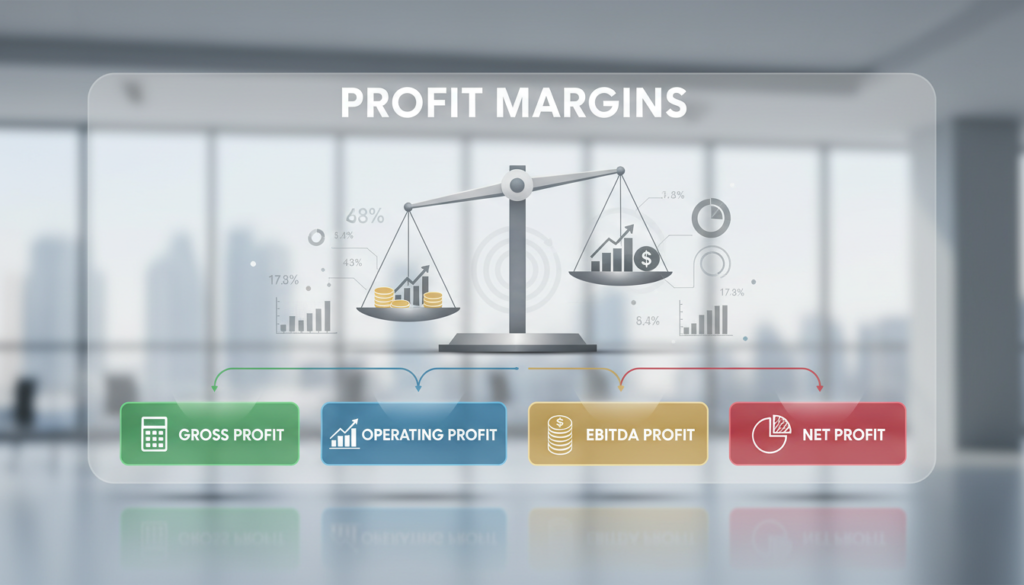
Types of Profit Margins to Know: Gross, Operating, EBITDA, and Net
Each margin level peels back another layer of operations to show real business health.
Gross profit margin shows product or service economics. Use it to see what remains after direct costs like COGS. This view helps with pricing and product mix decisions.
EBITDA margin adds back depreciation and amortization to earnings. Those are non-cash charges tied to past capital spending, so EBITDA highlights cash operating results for comparisons across companies.
Operating margin (EBIT) reflects core operations. It includes operating expenses such as payroll, rent, and marketing. This metric reveals how well operations control costs before financing and taxes.
Net profit margin is the bottom-line measure after interest and taxes. It uses net income and shows what a company truly keeps once financing and tax decisions are applied.
| Stage | Value | Calculation | Result |
|---|---|---|---|
| Revenue | $100 | — | 100% |
| Gross (Revenue − COGS) | $60 | ($100 − $40) ÷ $100 | 60% |
| EBITDA (adds back D&A) | $40 | (EBITDA ÷ Revenue) | 40% |
| Operating (EBIT) | $30 | EBIT ÷ Revenue | 30% |
| Net (after interest & taxes) | $20 | Net income ÷ Revenue | 20% |
When to use each: choose gross for pricing, operating for efficiency, EBITDA for cross-company comparisons, and net to gauge final profitability. Next, we’ll clear up a common mix-up between margin and markup.
Margin vs. Markup: Don’t Mix Up These Two Pricing Formulas
Many small businesses price with markup but report results using margin, and that mismatch causes problems. The two are related but use different bases, so identical dollars of earnings give different percentages.
Margin is based on revenue; markup is based on cost
Rule: margin uses revenue as the denominator; markup uses cost. In short, margin shows what share of a sale you keep, while markup shows how much you add to cost to set a price.
How to convert markup thinking into a target profit margin
If you want a target profit margin, price on revenue math rather than saying “cost plus X%.” First decide the percentage you need on sales. Then set the price so that after subtracting costs and fees you meet that percentage.
Why this matters: using markup when you meant margin can underprice goods. Discounts, processing fees, and shipping reduce your actual margin even if markup looks healthy.
Practical tips:
- Pick one method for internal talks—either markup or margin—and stick to it.
- Convert any cost-plus price into the margin percentage you track in reporting.
- Regularly recalc prices when costs or sales fees change to keep margins steady.
How to Analyze Profit Margins and Compare Performance Over Time
Before changing prices, learn which income-statement lines are actually pushing your results up or down.
Read the key lines: COGS, operating expenses (opex), interest, and taxes. COGS alters gross margin most directly. Opex moves operating margin. Interest and taxes change the final net figure.
Use operating and EBITDA margins to compare companies. They strip out financing and tax differences so you see core operations and cost control more clearly.
Track the same margin monthly or quarterly. Watch for step-changes tied to new hires, supplier price shifts, or marketing campaigns. Use consistent data windows so trends are valid.
Industry context matters. Software firms can show high gross margins but large opex (Salesforce). Retail runs thin gross margins but wins on volume (Walmart).
| Company | Revenue | COGS | Opex | Operating margin |
|---|---|---|---|---|
| Salesforce FY2021 | $21.3B | $5.4B | $15.4B | 2.1% |
| Walmart FY2021 | $559.2B | $420.3B | $116.3B | 4.0% |
- Segment by product, location, or customer to find the real drivers.
- Benchmark against industry ranges to define a good profit margin for your model.
- When you know the drivers, pull specific levers—pricing, labor, suppliers—to improve performance and financial health.
How to Increase Profit Margins Using Pricing, Cost Controls, and Efficiency
Small, focused changes to pricing, operations, and spending can raise overall business health quickly.
Reduce operating expenses with targeted reviews
Run a monthly cost checklist: software subscriptions, insurance, utilities, contractor spend, and overtime.
Cancel unused tools, renegotiate vendor terms, and trim duplicate services to protect your margins without cutting service quality.
Improve efficiency to protect margins
Better scheduling, clear SOPs, and brief training sessions reduce rework and raise gross profit per job.
Track one operations metric (order time, returns, or rework) and aim to improve it by 10% in the next period.
Optimize pricing strategy
Use dynamic price steps for peak demand, offer bundles to lift average order value, and add premium tiers where customers will pay more.
Test one price change on a small segment before rolling out to all customers.
Use product and service mix to boost overall results
Shift promotion and marketing toward higher-margin items. Even if revenue stays flat, this raises net performance.
Protect the net: ensure cost controls and pricing moves flow through to net profit and don’t get absorbed by creeping expenses.
| Action | Target | Expected effect |
|---|---|---|
| Subscription audit | Software & services | Reduce operating expenses by 3–7% |
| Labor scheduling & training | Staff hours per order | Lower costs, raise gross profit per job |
| Pricing tests | Dynamic pricing / bundles | Increase average order value and margins |
| Product mix shift | Promote high-margin offers | Lift overall profit margins with same revenue |
One monthly habit: review margins, pick one lever—cost, efficiency, price, or mix—run a small test, and track the next period’s performance.
Conclusion
,Wrap up by treating the percent as a simple lens that reveals different business truths depending on the metric chosen.
Core takeaway: the profit margin idea is easy: divide a chosen profit measure by revenue and multiply by 100. Which measure you pick—gross profit, operating, EBITDA, or net—changes the story the number tells.
Repeat the steps each period: identify revenue, define included costs and expenses, compute the profit, divide, then convert to a percent. Track both gross profit margin for pricing and delivery economics and net profit margin for true bottom-line health.
Compare results to past periods and industry ranges. Now do one thing: calculate last month’s margins, spot the biggest driver (COGS, operating expenses, interest, or taxes), and test a single improvement this month.