
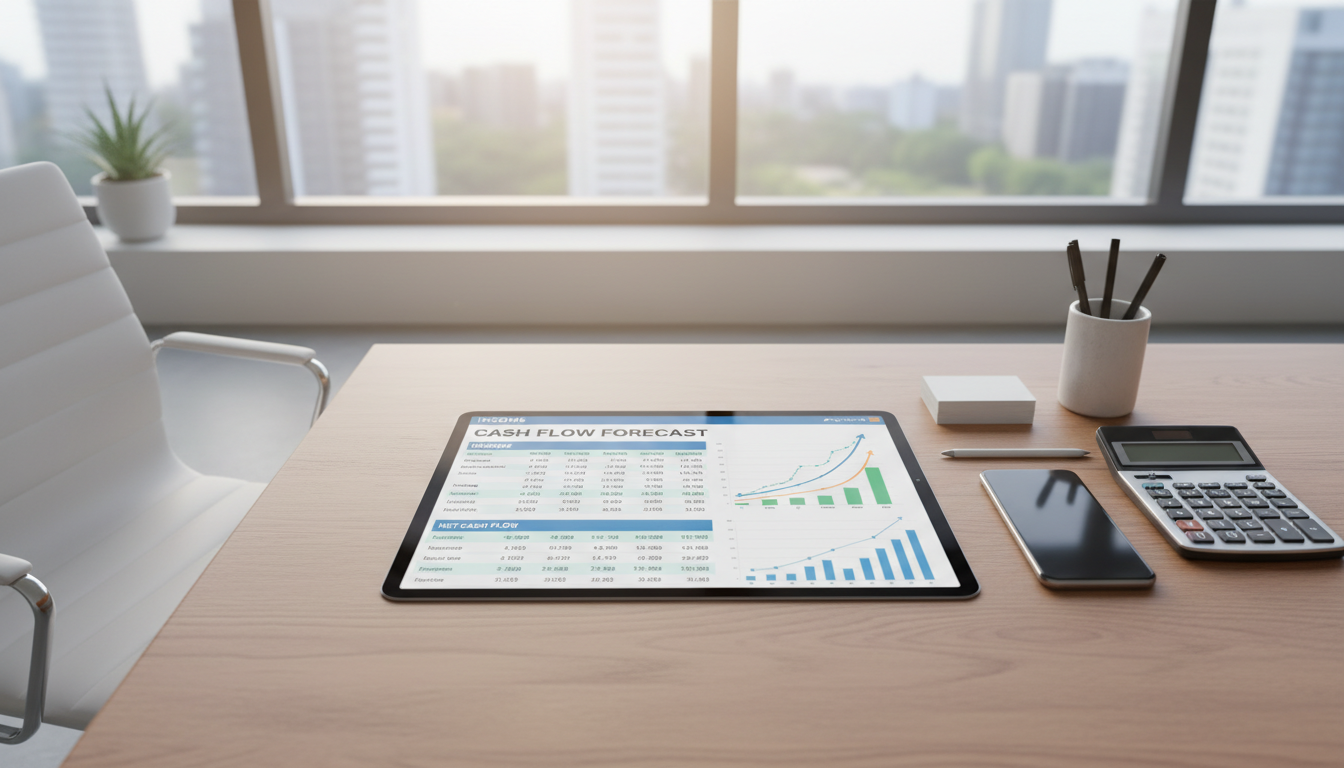
This short guide helps US small business owners and growing teams build a practical plan. You will learn how a simple spreadsheet can capture receipts, payments, net movement, and ending balances so you spot trends early.
Think of the file as a living tool. Update it regularly, and it will help you manage sure decisions about timing and needs. Even profitable companies can run tight if receipts arrive late.

The approach below shows clear steps to track money coming in and going out. The sheet will calculate totals and closing balances so you know if a shortfall or surplus is likely. We cover periods from daily and 13-week to 12-month, direct and indirect methods, and tracking actuals to improve accuracy.
Key Takeaways
- Build a repeatable sheet to track receipts, payments, and ending balances.
- Use the file as a living record and update it often to reduce surprises.
- Forecasting focuses on timing, not just profit.
- Choose the right period: daily, 13-week, or 12-month depending on needs.
- Track actuals alongside estimates to improve reliability over time.
What a cash flow forecast is and what it tells you
This short definition helps small teams get started fast. A practical cash flow forecast is a forward-looking plan. It estimates when money arrives, when payments leave, and how the bank balance changes over time.
What it is: a simple schedule that shows opening balance, expected receipts, expected payments, and closing balances for each period.
A plain definition for small business owners
It is a tool to manage liquidity. Use it to spot timing gaps so you can speed collections or delay spending before trouble starts.
What you’ll see at a glance
You will see three things: what you have today, what you expect later, and the changes caused by receipts and payments between those dates.
| View | Shows | Action |
|---|---|---|
| Today | Opening bank balance | Confirm starting funds |
| During period | Classified receipts and payments | Adjust timing or collections |
| End | Projected closing balance | Plan borrowing or investments |
Why cash flow forecasting matters for day-to-day liquidity
Knowing what funds will be available this week helps you avoid last-minute scrambling. Liquidity simply means you can pay payroll, vendors, rent, and taxes on time without panic.
How forecasts help prevent shortfalls and negative cash flow
Early warning beats emergency borrowing. A short-term forecast lets you spot when outflows will exceed inflows so you can act while options remain.
Actions before it’s too late include speeding up customer collections, delaying noncritical purchases, negotiating vendor terms, or shifting payment timing.
If a shortfall still looks likely, consider discussing a short-term loan with your banker while you can show a clear plan.
How to spot excess cash and plan smarter payments
Forecasts also reveal times of surplus. Use those windows to reduce expensive debt, prepay vendors for discounts, or invest in growth.
Make sure you treat forecasting as a habit: update actuals against estimates so the tool becomes more accurate and more valuable over time.
- Everyday liquidity = pay obligations on time.
- Forecasting gives early warning and choices.
- Act early: collect, delay, negotiate, or re-time payments.
- Show a plan to your banker when seeking help.
Core components every cash flow forecast should include
Start with a clear list of the parts your projection needs so it works for real decisions. The right pieces make the model actionable and easy to audit.
Opening balance for the period
Opening balance is the starting bank amount for the period. Match it to your real account balance, not a guess.
Receipts by item and total receipts
List receipts by business items that reflect how you collect money—customer payments, other revenue, and adjustments.
Include a Total Receipts line so you can compare income vs. outflows quickly.
Payments by item and total payments
Break payments into categories that mirror actual spending: payroll, rent, taxes, suppliers, and other costs.
Add a Total Payments line for an instant comparison with receipts.
Net movement and net cash flow
Net movement (receipts minus payments) is the key signal each period. It shows whether the projected cash increases or decreases.
Closing balance and ending bank balance
The closing balance equals opening balance plus net movement. That ending balance becomes the next period’s opening balance.
- Include a simple example layout so multiple users enter consistent figures.
- Keep item names consistent across periods to improve accuracy.
| Component | What it shows | Why it matters |
|---|---|---|
| Opening balance | Starting amount | Sets the real starting point |
| Total receipts | All incoming amounts | Tracks inflow by items |
| Total payments | All outgoing amounts | Shows outflow by items |
| Closing balance | Projected ending balance | Feeds the next period |
Pick the right forecast period for your business
Picking the right time horizon helps you focus on near-term survival or long-term strategy. Choose a period based on the decisions you face each week, month, or year.
Short-term cash flow forecast for daily cash needs
Daily projections cover a couple of weeks with a day-by-day view. They suit retailers, restaurants, or any business with fast pay cycles and frequent vendor bills.
Automating bank or ERP feeds makes daily tracking practical and lowers manual work.
Medium-term cash flow projections with a rolling 13-week view
A rolling 13-week model gives quarterly visibility. It helps plan payroll runs, tax dates, and supplier payments.
This is a good balance: detailed enough to act, but not as granular as daily tracking.
Long-term cash flow projections for a 12-month plan and budgeting
Use 12-month projections for budgeting, capital projects, and strategy. They show trends and funding needs over the year, though month-to-month precision is lower.
Mixed-period forecasts that zoom in where it matters most
Combine daily or weekly detail near term with weekly or monthly summaries later. Keep assumptions consistent so columns roll up cleanly.
- Trade-off: The further the horizon, the less certainty you have.
- Different periods can coexist in one spreadsheet when designed carefully.
- Decision match (an example): daily for survival, 13-week for control, 12-month for strategy.
| Period | Use | Best for |
|---|---|---|
| Daily / Days | Immediate timing | High-frequency operations |
| 13-week | Quarterly planning | Payroll and supplier scheduling |
| 12-month / Year | Budgeting | Strategy and capital plans |
Choose a forecasting method that fits your data
Match your method to the data you actually have and how often you need to act.
Direct forecasting for weekly or daily cash flow projections
Direct forecasting lists expected receipts and expected payments by date. It uses bank, AR, and AP records and is updated weekly or daily.
This way maps closely to what hits the bank account. Small businesses benefit most because it shows near-term shortages or surplus and supports quick decisions.
Indirect forecasting for planning with income statements and longer horizons
Indirect forecasting starts with income statements and profit projections. You then adjust for non-cash items and working capital timing to estimate cash impact.
It works well for longer-range budgeting or larger companies with stable reporting cycles. Use it when you need high-level projections rather than day-to-day control.
- Direct = receipts/payments by date; best for near-term control.
- Indirect = income-based adjustments; best for budgeting and longer horizons.
- Data freshness matters: more frequent bank and AR/AP updates make short-term projections more useful.
- The best way matches your company’s reporting cadence and input quality, not complexity.
Gather the information you need before you start
Before you build any sheet, collect the facts that define your starting point and timing.
Begin with the opening balance. Pull current bank balances for each account you use—operating, payroll, and any reserve accounts. That number is your cash flow statement starting point and sets the baseline for every period.
Next, assemble expected inflows. Gather recent sales data, customer payment timing from invoices and terms, and any other revenue that will deposit into accounts. Use real numbers from the last few months where possible.

Then list expected outflows. Include bills by due date, payroll schedules, tax payment dates, subscriptions, loan payments, and regular overhead like rent, utilities, and insurance. Timing matters—use deposit and payment dates, not just invoice dates.
- Start with real bank balances so the opening balance is correct.
- Collect sales, customer receipts, and other revenue timing.
- Record bills, payroll, taxes, subscriptions, and loan dates for accurate payments.
- Use recent months of numbers; best guesses become risky fast.
- Organize all data in one place before you build the sheet to avoid stops and searches.
Cash flow forecast template: how to set up your spreadsheet
Set up a plain spreadsheet where categories sit in rows and time periods form the columns. This makes the file easy to read and fast to update.
How to structure rows for receipts and payments
Use rows to list receipts by item or classification: customer receipts, other revenue, and adjustments. Add separate rows for AR and any uncommon income.
For payments, create rows for payroll, rent, suppliers, taxes, and loan payments. Reserve rows for subtotals and a total payments line.
How to structure columns by month, week, or day
Choose columns by how quickly your position changes. Use day columns if timing matters daily, weekly for short-term planning, or month columns for budgeting.
What to customize for your company
If a few customers drive most income, add customer-level rows. Early-stage firms may prefer high-level AR/AP only. Keep naming consistent so edits stay clean—this is template help.
“A clear layout turns numbers into decisions.”
| Area | Example rows | Why it helps |
|---|---|---|
| Receipts | Customer payments, Other revenue, AR | Shows timing by item |
| Payments | Payroll, Rent, Suppliers, Taxes | Tracks obligations |
| Totals | Net movement, Closing balance | Reads clearly for decisions |
Fill in your receipts with realistic sales and revenue assumptions
Build receipt projections from real sales history so your plan matches what actually happens. Use last year’s figures or recent sales data as the basis for each month. That gives you a defensible starting point for any forecast.
Adjust for seasonality and market shifts. Increase receipts for busy months and dial them back for slow periods. Add planned promotions, pricing changes, or product launches so revenue projections reflect likely outcomes.
Turn numbers into realistic monthly entries
Use conservative assumptions first. Enter the date you expect funds to land in the account, not the invoice date. This keeps cash flow projections grounded in real timing.
- Start from last year’s sales or the most recent data, not guesses.
- For startups, use industry trends and competitor context to set initial sales levels.
- Sanity-check totals against capacity—staff, inventory, and production limits.
| Item | Example | Why |
|---|---|---|
| Basis | Last year’s monthly numbers | Realistic starting point |
| Adjustments | Seasonality, promotions | Improves accuracy |
| Timing | Receipt date vs invoice date | Shows true inflows |
Estimate expenses the way your money actually goes out
Estimate expenses by tracking exactly when and how funds leave your accounts so your plan matches reality.
Mirror bank timing and payment frequency. Include the date each payment clears, and note whether it is weekly, monthly, or annual. That helps you see true short-term pressure and longer-term trends.
Direct, variable items
List materials, stock, packaging, and other direct costs that scale with sales. Tie these lines to your revenue assumptions so they rise and fall as volume changes.
Regular overhead
Include payroll, insurance, utilities, marketing, and subscriptions. Many of these are fixed monthly payments and create steady outflows you must cover.
Quiet drains to watch
Don’t forget interest, bank fees, repairs and maintenance, and tax payments that arrive in lumps. These often get missed but can dent your balance quickly.
Review prior bank statements to find recurring charges, annual renewals, and one-time deposits or equipment purchases. Add those to the plan so the next period’s balance is realistic.
| Type | Examples | Why include it |
|---|---|---|
| Direct | Materials, packaging, stock | Scales with sales; affects gross margins |
| Overhead | Payroll, insurance, marketing, subscriptions | Predictable monthly payments to budget |
| Quiet drains | Interest, bank fees, repairs, taxes | Irregular but material; prevents surprises |
| One-time | Equipment deposits, large premiums | Creates temporary dips to plan for |
Calculate totals, net cash flow, and your projected balance
Start by summing every receipt and payment column so the picture for each month is clear.
Total receipts vs. total cash payments
For each period, add a Total Receipts row and a Total Payments row. Place those totals at the column bottoms so you can compare inflows and outflows instantly.
Net cash for the month and the full period
Net cash equals Total Receipts minus Total Payments. Track that line monthly and for the entire forecast period to see whether the position improves or worsens.
Closing bank balance and the next period’s opening balance
Calculate the projected cash balance with a simple formula: Opening Balance + Net Cash = Closing Balance. The closing balance rolls forward as the next period’s opening balance, preserving continuity.
- Copy formulas across columns to keep totals consistent.
- Double-check cell references when copying so sums stay accurate.
- Remember: a positive net cash month can still be risky if the opening balance is low or if large payments are due next period.
| Calculation | Example | Why it matters |
|---|---|---|
| Total Receipts | $50,000 | Shows inflows per month |
| Total Payments | $42,000 | Shows outflows per month |
| Net Cash | $8,000 | Key monthly indicator of change |
Use the template to run scenarios and improve accuracy over time
Try simple “what if” runs to compare outcomes before committing to spending or growth.
Add an “Actual” line next to your projected columns so you can compare predicted numbers with what really happened. Capture actuals in the same model each week or month. This keeps your projections rooted in real starting points and helps spot patterns fast.
Track actuals and measure forecast accuracy
Enter realized receipts and payments beside estimates. Then calculate variance to see where your assumptions missed.
Run practical scenario examples
Model hires, equipment purchases, short-term loans, or expanded capacity to view timing and amounts. Use the results to weigh options before you spend.
When a shortfall appears
Adjust timing: speed collections, negotiate vendor dates, or pause nonessential costs. If needed, talk with your banker early and bring projections to support a loan request.
How often to update
Fast-moving businesses should refresh weekly. Others can use monthly updates and a rolling approach that extends the projections each time you submit new data.
| Scenario | Action | Likely impact |
|---|---|---|
| Hire salesperson | Model salary + ramp | Short-term dip; revenue rise after 3–6 months |
| Buy equipment | Compare upfront cost vs financing | Large immediate outlay; smaller periodic payments if financed |
| Take a short-term loan | Run repayment schedule | Improves liquidity now; interest adds to costs |
| Increase capacity | Estimate incremental receipts and costs | Higher operating costs; potential revenue growth |
Conclusion
Conclusion
Choose one clear period and commit to a short weekly review. A simple cash flow gives fast visibility into what’s coming and helps you protect liquidity.
Use the workflow you learned: pick a period, gather inputs, record receipts and payments realistically, then calculate net cash and balances. Update the model regularly so it stays reliable.
Start simple with high‑level categories and add detail only where it helps decisions, such as major customers or large recurring charges. Keep accountability: regular checks turn a spreadsheet into a tool that guides the company.
Next step: download or build your template, block time each week to update it, and use the results to time payments and support growth. Even a basic template adds real value—less stress, stronger choices, and fewer avoidable shortages.